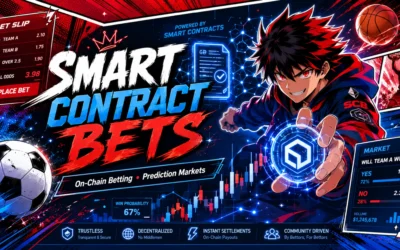




As decentralized technologies reshape the landscape of finance and gaming, prediction markets and crypto sportsbooks are beginning to overlap in ways that both challenge and complement each other. This article breaks down the differences, shared mechanics, and evolving convergence between these two powerful Web3 sectors — and explores how platforms like SmartContractBets.xyz can lead the next wave of hybrid innovation.
What Are Prediction Markets?
Prediction markets are decentralized platforms where users trade shares in the outcome of future events — political elections, sporting results, economic forecasts, or pop culture moments. Unlike traditional sportsbooks, these markets don’t “offer odds” per se. Instead, prices are determined by supply and demand. If a market asks, “Will Team A win the championship?”, and shares are trading at $0.65, it implies a 65% probability.
Once the outcome resolves, winning shares are redeemable for $1, and losing shares become worthless. This model, known as a binary scoring rule (e.g., 0 or 1), enables real-time crowd forecasting and creates opportunities for arbitrage when market probabilities diverge from statistical reality or bookmaker odds.
Popular prediction markets include:
- Polymarket (Polygon-based)
- Augur (Ethereum-based)
- Omen (built on Gnosis)
How Sportsbooks Operate
Traditional sportsbooks, including on-chain variants like SmartContractBets.xyz, offer pre-defined odds on sporting outcomes. These odds incorporate a margin or “vig,” typically ranging from 3% to 10%, depending on the event and the market’s liquidity. Bettors wager funds on these odds, and if they win, they receive a payout based on the implied probability — minus the house edge.
Betting markets in sportsbooks are often richer in complexity than those on prediction platforms. Markets can include:
- Match winner
- Map or round winners
- Total points
- Handicaps
- Props like “first blood” in esports or “goal scorer” in football
Fee Structures and Payout Models
| Feature | Prediction Markets | Crypto Sportsbooks |
|---|---|---|
| Fee Structure | Low protocol fees (1–2%) | House edge baked into odds (3–10%) |
| Payouts | Binary (0 or 1 per share) | Variable based on odds |
| Liquidity Model | AMM / User funded pools | Bookmaker or liquidity pools |
| Market Creation | Open to users (Polymarket via UMA) | Pre-selected events by operators |
| Risk Exposure | Peer-to-peer | Book-managed or decentralized pools |
Prediction markets aim to be neutral, with the platform itself not taking sides. In contrast, sportsbooks earn profit by setting odds that ensure they win over the long term — unless they’re decentralized pools like Azuro-powered platforms (e.g., SmartContractBets.xyz), which function more like automated bookies backed by liquidity providers.
Overlapping User Bases and Arbitrage Potential
A growing number of users participate in both prediction markets and sportsbooks — traders, punters, and data-driven bettors seeking edge.
This creates cross-platform arbitrage opportunities, such as:
- When Polymarket has “YES” for a team at $0.80 (20% ROI), but a sportsbook offers odds that imply only a 15% probability, arbitrageurs can profit by hedging.
- When liquidity gaps exist — such as during low-volume trading hours or market delays after injury or breaking news — sharp users can exploit price inefficiencies.
AI-driven bots are increasingly used to monitor multiple platforms for such opportunities.
Regulatory Distinctions: The CFTC Line
Prediction markets are closely watched by regulators like the U.S. Commodity Futures Trading Commission (CFTC), which governs markets that resemble derivatives. Platforms like Kalshi have sought formal approval to operate U.S.-regulated prediction markets on events like inflation or election outcomes.
Sportsbooks, on the other hand, fall under state-by-state or national gambling laws. In many jurisdictions, prediction markets operate in a gray zone or are geofenced.
This divergence in regulatory treatment creates challenges:
- Prediction markets face caps on bet sizes or restrictions on specific topics.
- Sportsbooks must acquire licenses but often face fewer content restrictions.
SmartContractBets.xyz, being decentralized and jurisdiction-agnostic, sidesteps many traditional hurdles — but must remain cautious about offering “financial prediction” markets that could attract regulatory attention.
Future Synergies: SmartContractBets.xyz as a Hybrid Layer
SmartContractBets.xyz is well-positioned to blur the lines between betting and prediction. Here’s how:
1. Modular Prediction Markets
Enable users to create markets not just on sports but on sports-adjacent events like:
- “Will player X start?”
- “Will VAR intervene?”
- “Will the match finish before midnight?”
This could be built using Polymarket-style resolution oracles or integrations with protocols like UMA or Reality.eth.
2. Meta-Market Aggregation
Pull real-time probabilities from both sportsbooks and prediction markets into a single interface, allowing users to “bet the edge.” For example, if a bet is 60% on Sportsbook A and 70% on Polymarket, a user could click “arbitrage opportunity” and place offsetting bets.
3. AI-Powered Price Discovery
Use AI agents to synthesize probabilities from prediction markets and liquidity-based odds to offer dynamic pricing or suggest optimal betting strategies across platforms.
4. Staking and Liquidity Flywheels
Liquidity providers in SmartContractBets.xyz could earn fees from both traditional sportsbook bets and prediction-style markets — diversifying revenue and boosting APY.
Final Thoughts
Prediction markets and sportsbooks are converging rapidly, driven by decentralization, data-driven wagering, and global demand for fairer, more transparent systems. But they still differ in mechanism, risk models, and regulation.
SmartContractBets.xyz sits at the ideal crossroads — capable of combining the game theory of prediction markets with the real-world thrills of sports betting.
By embracing hybrid design, enabling community market creation, and offering smart, AI-assisted odds aggregation, it can evolve into the ultimate Web3 betting hub — where every outcome, idea, or event becomes a trading opportunity.