
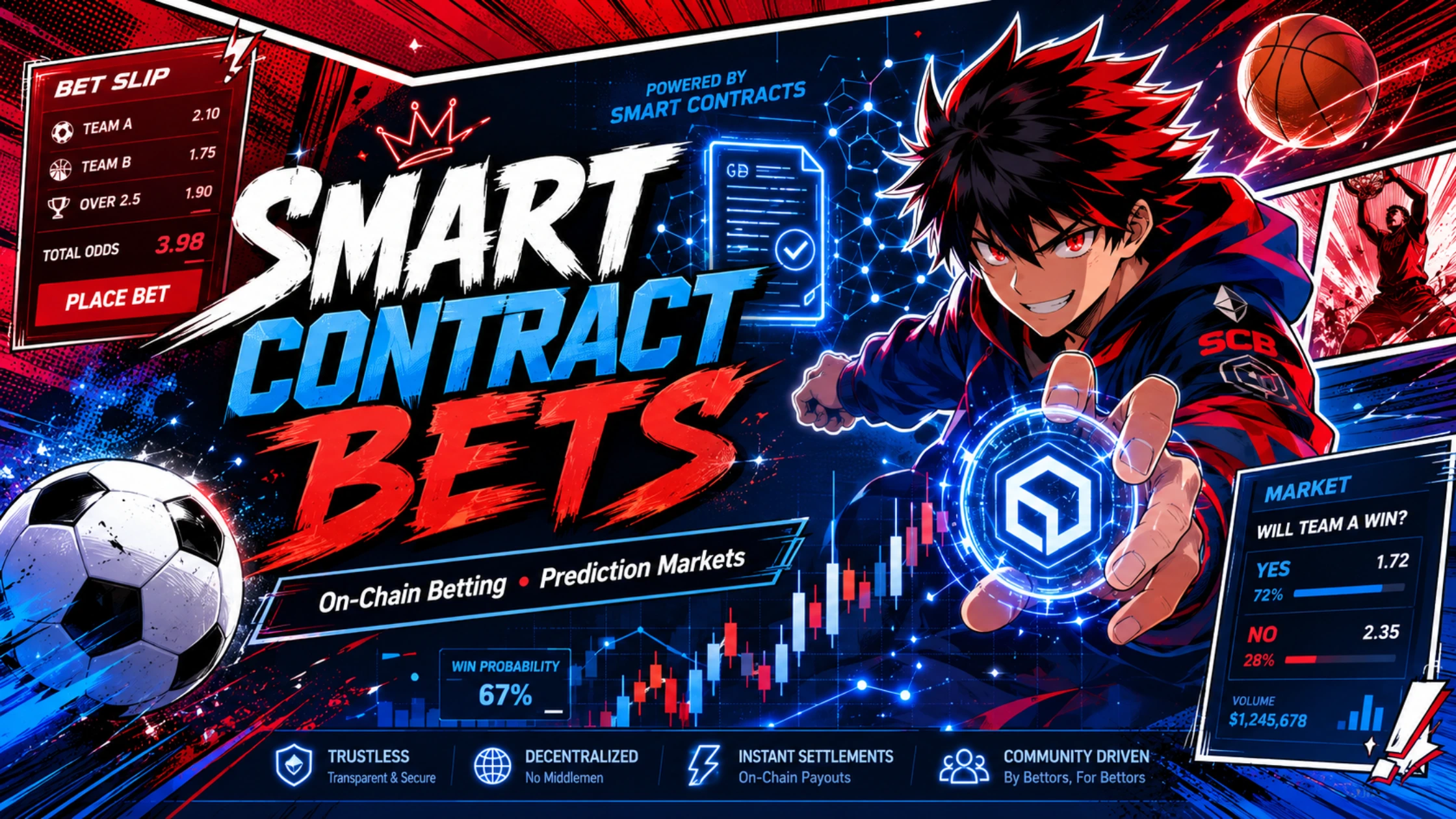


How On-Chain Prediction Markets Are Changing Sports Betting, Crypto Forecasting, Politics, Finance and Event Trading
Prediction markets are one of the biggest shifts happening at the intersection of crypto, betting and finance.
For decades, people have tried to predict the future using polls, pundits, analysts, models and media narratives.
Prediction markets take a different approach.
They ask people to put capital behind their opinions.
That changes everything.
When real money is involved, weak opinions disappear faster. People stop guessing for attention and start pricing probabilities with consequences.
That is the core idea behind prediction markets.
A prediction market lets users trade the outcome of real-world events.
Will Bitcoin hit a certain price?
Will a team win a championship?
Will the Fed cut rates?
Will a candidate win an election?
Will a new crypto law pass?
Will a major ETF be approved?
Instead of asking, “What do people think?”
Prediction markets ask:
What probability are people willing to back with money?
For Smart Contract Bets, this matters because prediction markets are a natural extension of on-chain betting.
They show how smart contracts, transparent settlement and crypto-native markets can make event-based wagering more open, more efficient and more data-driven.
This guide explains how prediction markets work, why they are different from traditional sportsbooks, which platforms matter, what risks users need to understand, and why on-chain betting could become one of the most important financial and entertainment markets of the next decade.
Quick Summary
Prediction markets are platforms where users trade contracts based on whether a future event happens.
A YES contract priced at $0.40 usually implies the market believes there is a 40% chance of that event happening.
If the event happens, YES wins.
If it does not, NO wins.
The biggest prediction market platforms in 2026 include:
Polymarket.
Kalshi.
Robinhood Predictions.
Gemini Olympus.
Drift BET.
Limitless.
Azuro.
SX Bet.
Hedgehog Markets.
Omen.
Zeitgeist.
Polkamarkets.
Manifold Markets.
O.LAB.
Myriad.
Prediction markets are used for:
Sports outcomes.
Crypto price milestones.
Elections.
Economic data.
Interest-rate decisions.
Regulatory events.
Technology launches.
Cultural events.
The main benefit is simple:
Prediction markets turn uncertainty into a live price.
The main risk is also simple:
A market price is not a guarantee. It is only the crowd’s current probability estimate.
What Is a Crypto Prediction Market?
A crypto prediction market is a blockchain-based marketplace where users trade the probability of real-world outcomes.
The simplest version is a binary market.
That means there are two sides:
YES.
NO.
Example:
“Will Bitcoin reach $200,000 before January 2027?”
If YES trades at $0.35, the market is implying roughly a 35% probability.
If YES wins, each YES share pays $1.
If YES loses, it pays $0.
This creates a simple trading structure.
Buy YES if you think the probability is too low.
Buy NO if you think the probability is too high.
The price moves as new information arrives.
If Bitcoin rallies, YES may rise.
If Bitcoin crashes, YES may fall.
If a key regulatory approval improves the odds, the market adjusts.
This is what makes prediction markets powerful.
They do not just record opinions.
They update in real time as the world changes.
Why Prediction Markets Matter for Smart Contract Betting
Smart contract betting is built on the idea that users should not have to rely entirely on a centralized operator to decide outcomes, hold funds or process payouts.
Prediction markets take that idea further.
They create tradable markets around events, with rules, collateral and settlement systems built into the platform.
In a traditional sportsbook, the platform sets the odds.
In a prediction market, users trade against each other and the price reflects market demand.
That means prediction markets can become:
A betting layer.
A forecasting tool.
A hedging market.
A public probability dashboard.
A financial product.
A sports trading venue.
A crypto-native information market.
For users, this can be more transparent than traditional odds.
For analysts, it can be more useful than polls.
For bettors, it creates more flexible ways to enter and exit positions before an event resolves.
For crypto builders, it shows how smart contracts can turn real-world uncertainty into programmable markets.
Prediction Markets vs Traditional Sportsbooks
Prediction markets and sportsbooks can look similar, but they are not the same.
A sportsbook usually sets odds.
The user bets against the bookmaker.
The bookmaker builds in a margin.
The house expects to win over time.
Prediction markets usually work more like exchanges.
Users buy and sell outcome contracts against each other.
The platform may charge a fee, but the price is shaped by market activity.
This difference matters.
In a sportsbook, odds may include a house edge.
In a prediction market, prices can move more freely based on user demand, news, liquidity and information.
That does not mean prediction markets are automatically better.
Thin markets can be mispriced.
Low-liquidity markets can be manipulated.
Resolution disputes can happen.
But the structure is different enough that users should understand both models separately.
Prediction Markets vs Crypto Betting
Crypto betting usually means using crypto to bet on sports, casino games or other outcomes.
The platform may still be centralized.
Crypto is just the payment method.
On-chain prediction markets go further.
They can use:
Smart contracts.
Stablecoin settlement.
Wallet-based access.
On-chain collateral.
Transparent rules.
Decentralized oracles.
Tokenized YES and NO contracts.
That is why prediction markets are important for the future of crypto betting.
They move the industry from “pay with crypto” toward “settle outcomes through programmable infrastructure.”
For Smart Contract Bets, this is the key distinction.
The future is not just crypto deposits.
The future is transparent, verifiable, smart-contract-based event settlement.
How Prediction Market Prices Work
Prediction market prices are easy to read.
A contract priced at $0.25 implies roughly a 25% chance.
A contract priced at $0.50 implies a 50% chance.
A contract priced at $0.80 implies an 80% chance.
If the market resolves correctly, the winning side usually pays $1.
So if you buy YES at $0.30 and it wins, your payout is $1 per share.
If it loses, your position goes to zero.
That creates a clear risk-reward structure.
A low-probability longshot may offer a high payout, but the risk of losing is high.
A high-probability outcome may feel safer, but the return is smaller.
This is where discipline matters.
Prediction markets can look simple, but they punish emotional betting.
Why Prediction Markets Can Be More Accurate Than Polls
Prediction markets often become powerful because users have skin in the game.
A person answering a poll may be careless.
A commentator may be biased.
A pundit may want attention.
A trader risking money has a stronger incentive to be accurate.
This does not make prediction markets perfect.
They can still be wrong.
They can still be manipulated.
They can still overreact.
But when a market has enough liquidity and informed participants, the price can become a useful probability signal.
That is why journalists, traders, researchers and political analysts increasingly watch platforms like Polymarket and Kalshi.
The market price becomes a live forecast.
Not a guarantee.
A forecast.
Polymarket: The Crypto-Native Prediction Market Leader
Polymarket is the best-known crypto-native prediction market.
It became famous for political markets and later expanded into crypto, sports, culture, technology and macroeconomic events.
Polymarket is important because it made prediction markets mainstream in crypto.
Users could trade real-world probabilities using stablecoins and wallet-based infrastructure.
This helped prediction markets move from a niche idea into a major information tool.
Why Polymarket matters
Polymarket proved that crypto prediction markets can attract real liquidity, real media attention and real cultural relevance.
It also proved that people want a market price for uncertain events.
Best for
Crypto-native users.
Politics.
Crypto price predictions.
Sports markets.
Macro event trading.
Culture and technology outcomes.
Risks
Oracle disputes.
Regulatory restrictions.
Wallet and stablecoin risk.
Market wording ambiguity.
Thin-market manipulation.
Polymarket is powerful, but users must read the rules before trading.
Kalshi: Regulated Event Contracts
Kalshi is one of the most important regulated prediction market platforms in the United States.
Unlike crypto-native platforms, Kalshi operates more like a regulated financial exchange for event contracts.
This matters because mainstream users, institutions and fintech platforms often prefer regulated rails.
Kalshi shows that prediction markets are not only a crypto idea.
They are becoming part of mainstream finance.
Best for
U.S. users.
Regulated event contracts.
Fiat-native access.
Macro markets.
Political events.
Sports where available.
Users who prefer a compliance-first experience.
Risks
Market availability may vary.
Sports markets can face state-level restrictions.
Regulated structures may limit permissionless market creation.
Robinhood, Gemini, DraftKings and FanDuel Enter the Market
Prediction markets are no longer only for crypto-native users.
Robinhood’s move into prediction markets is important because it brings event trading into an app millions of users already know.
Gemini is building prediction market infrastructure from a crypto-regulated angle.
DraftKings and FanDuel entering the space shows that sports betting companies understand the threat and opportunity.
This creates a huge shift.
Prediction markets may become embedded inside:
Trading apps.
Sports platforms.
Crypto exchanges.
Wallets.
Brokerages.
Media platforms.
Betting apps.
That means event-based trading may become as normal as buying stocks or placing sports bets.
Drift BET: Solana Prediction Markets
Drift BET is a Solana-native prediction market product connected to the Drift ecosystem.
It is important because Solana is fast, low-cost and popular with active crypto traders.
Drift BET also explores more capital-efficient prediction market design by connecting prediction exposure with DeFi-style collateral mechanics.
Best for
Solana users.
DeFi-native traders.
Crypto event markets.
Multi-asset collateral strategies.
Capital-efficient event trading.
Risks
More complex than simple betting.
Smaller market selection than Polymarket.
DeFi and smart contract risks.
Limitless: Prediction Markets on Base
Limitless is a prediction market built on Base, the Ethereum Layer 2 connected to Coinbase’s ecosystem.
Base is important because it combines Ethereum-style infrastructure with lower costs and strong consumer distribution potential.
Limitless is more trading-oriented than casual betting-oriented.
Best for
Base users.
Crypto prediction markets.
Professional-style interfaces.
Coinbase-adjacent on-chain users.
Risks
Smaller liquidity than top platforms.
Early-stage platform risk.
Base ecosystem dependency.
Azuro: Prediction Market Infrastructure
Azuro is different from Polymarket or Kalshi.
It is more of an infrastructure layer for sports prediction and betting markets.
Developers can build applications on top of Azuro rather than creating everything from scratch.
This matters because the future of smart contract betting may not come from one platform.
It may come from protocols that power many betting applications.
Best for
Developers.
Sports betting apps.
Prediction market builders.
Liquidity providers.
On-chain betting infrastructure.
Risks
Infrastructure complexity.
Frontend quality varies.
Sports-heavy exposure.
Liquidity provider risk.
SX Bet: Long-Running Web3 Betting
SX Bet is one of the longer-running Web3 betting platforms.
Longevity matters in crypto because many projects disappear quickly.
SX Bet focuses heavily on sports and betting-style markets with Web3 rails.
Best for
Sports bettors.
Web3 betting users.
Niche sports markets.
Users who value operating history.
Risks
Regulatory uncertainty.
Sports market concentration.
Smaller mainstream visibility.
Other Prediction Market Platforms to Know
Hedgehog Markets
A Solana-based platform with a more accessible experience for newer prediction market users.
Omen
A Gnosis-based prediction market tied to the original decentralized prediction market vision.
Zeitgeist
A Polkadot-based forecasting and governance market.
Polkamarkets
A multi-chain prediction market using automated market maker mechanics.
Manifold Markets
A play-money prediction market useful for learning and experimenting without real-money risk.
O.LAB
A newer platform focused on reputation, calibration and forecast accuracy.
Myriad
A community-driven prediction platform with social forecasting features.
How Prediction Markets Resolve Outcomes
The most important part of any prediction market is resolution.
A market is only useful if the final outcome is decided fairly.
Different platforms resolve events differently.
Oracle-based resolution
Crypto-native markets often use oracles.
An oracle brings real-world information on-chain.
For example:
Election results.
Sports scores.
Crypto prices.
Government data.
ETF approvals.
If the oracle system works, the market resolves correctly.
If it fails, users can lose trust.
UMA and Polymarket
Polymarket uses an oracle process involving proposals and disputes.
This can work well, but it has also faced controversy.
The lesson is simple:
Prediction market users must understand oracle risk.
Automated price feeds
Some crypto price markets can use automated feeds from systems like Pyth.
This is easier when the outcome is objective.
Example:
“Did BTC trade above $150,000 before this date?”
That can be checked using price data.
Centralized regulated resolution
Platforms like Kalshi may use official sources and regulated exchange rules.
This may be less decentralized but clearer for institutional users.
The Biggest Risks in Prediction Markets
1. Oracle risk
If the platform resolves the event incorrectly, users can lose money even if their real-world thesis was right.
2. Market wording risk
Market titles can be misleading.
Always read the rules.
A single word can change the payout.
3. Liquidity risk
Thin markets can have bad pricing.
Low liquidity can make it hard to enter or exit.
4. Longshot bias
Users often overpay for exciting low-probability outcomes.
A 5% event may trade at 12% because people like lottery-style upside.
5. Regulation risk
Prediction markets sit between finance, betting and derivatives.
Rules can change quickly.
6. Emotional betting
Prediction markets are dangerous when users trade based on politics, fandom or hope instead of probability.
7. Retail loss risk
Many casual users lose money because they chase headlines, longshots and emotionally satisfying positions.
Prediction Market Strategies
Information edge
Trade only where you understand the event better than the market.
A sports analyst should focus on sports.
A crypto analyst should focus on crypto markets.
A macro analyst should focus on rates and inflation.
Do not trade everything.
Cross-platform arbitrage
Sometimes the same event trades at different probabilities on different platforms.
Advanced traders can exploit that gap.
But this is becoming harder as bots and professional traders enter.
High-probability trading
Some users buy outcomes priced near 90% or higher and wait for resolution.
This can work, but hidden risks include disputes, wording problems and unexpected events.
Longshot fading
Low-probability outcomes are often overpriced because people like big payouts.
Advanced traders may take the opposite side of overhyped longshots.
Liquidity provision
Market makers can earn spreads by providing buy and sell liquidity.
This requires experience and strong risk management.
Why Prediction Markets Matter for Sports Betting
Prediction markets could change sports betting in several ways.
They can allow users to trade in and out before the event ends.
They can create more transparent implied probabilities.
They can allow market-driven odds rather than bookmaker-set odds.
They can support on-chain settlement.
They can create new sports outcome markets.
They can combine betting, trading and forecasting into one experience.
This is why platforms like Smart Contract Bets should pay attention.
Sports betting is moving from simple wagers toward tradable event markets.
That does not replace traditional betting overnight.
But it expands the possibilities.
The future sports bettor may not only place a bet.
They may trade the probability of the outcome throughout the event lifecycle.
Smart Contract Betting vs Traditional Betting
Smart contract betting can improve several parts of the betting experience.
Transparency
Users can verify how contracts work.
Settlement
Payout logic can be automated.
Custody
Users may not need to keep long-term balances with a centralized operator.
Global access
Crypto rails can improve cross-border participation where legally permitted.
Faster payouts
Smart contracts can reduce withdrawal friction.
Composability
Markets can connect with DeFi, wallets, analytics and automated strategies.
But smart contract betting also has risks:
Smart contract bugs.
Oracle failures.
Regulatory limits.
User wallet mistakes.
Liquidity challenges.
Market manipulation.
The best platforms will be the ones that combine transparency with responsible design.
Responsible Prediction Market Use
Prediction markets are 18+ products.
They are not risk-free.
Users should only participate where it is legal and only with money they can afford to lose.
Responsible rules:
Do not chase losses.
Do not bet emotionally.
Do not use borrowed money.
Do not assume market prices are always correct.
Do not overbet longshots.
Read the resolution rules.
Start small.
Track performance.
Take breaks.
Understand local laws.
Prediction markets can be useful and entertaining, but they must be treated with discipline.
Best Platform Types by User
Best for crypto-native prediction trading
Polymarket.
Best for regulated U.S. users
Kalshi.
Best for mainstream app access
Robinhood Predictions.
Best for Solana users
Drift BET.
Best for Base users
Limitless.
Best for sports betting infrastructure
Azuro.
Best for Web3 sports betting
SX Bet.
Best for learning without real money
Manifold Markets.
Best for decentralized governance experiments
Zeitgeist.
How Beginners Should Start
Step 1: Learn with small markets
Do not start by placing large trades on political or sports outcomes.
Learn how pricing, resolution and payouts work.
Step 2: Read the full rules
Never trade based only on the headline.
The market details decide the outcome.
Step 3: Avoid emotional topics
People make poor decisions when they trade politics, fandom or narratives they personally want to be true.
Step 4: Specialize
Pick one area where you understand the data.
Sports.
Crypto.
Macro.
Regulation.
Politics.
Do not trade everything.
Step 5: Manage position size
Even a 95% market can lose.
Never risk too much on one outcome.
FAQ
What is a crypto prediction market?
A crypto prediction market is a platform where users trade contracts based on whether real-world events will happen. Prices reflect the market’s implied probability.
Is a prediction market the same as a sportsbook?
No. A sportsbook usually sets odds and acts as the counterparty. A prediction market usually lets users trade outcome contracts against each other, more like an exchange.
What is Polymarket?
Polymarket is a crypto-native prediction market known for political, crypto, sports, macro and cultural event markets.
What is Kalshi?
Kalshi is a regulated U.S. prediction market for event contracts.
Can prediction markets be used for sports?
Yes. Sports are one of the fastest-growing prediction market categories, but availability depends on platform rules and local laws.
Are prediction markets legal?
It depends on your country, state and platform. Some platforms are regulated event-contract exchanges. Others may be restricted in certain jurisdictions. Always check local rules.
What is oracle risk?
Oracle risk is the risk that the system responsible for deciding the outcome gets it wrong, is manipulated or produces a disputed result.
Can users make money from prediction markets?
Yes, but many users lose money. Successful traders usually have strong information, discipline and risk management.
Why are prediction markets important for smart contract betting?
They show how real-world events can be turned into transparent, tradeable, smart-contract-based markets. This is directly connected to the future of on-chain betting.
Final Verdict
Prediction markets are not just a new way to gamble.
They are a new way to price reality.
They turn uncertain events into live probabilities.
They allow users to trade information, not just assets.
For sports betting, they may unlock more transparent and tradable odds.
For crypto, they show how smart contracts can settle real-world outcomes.
For finance, they create a new asset class around event risk.
For users, they offer opportunity and danger in equal measure.
The opportunity is that prediction markets can be smarter, faster and more transparent than traditional forecasting.
The danger is that they can still be manipulated, mispriced, misunderstood or regulated out of reach.
Smart Contract Bets believes the future of betting is moving on-chain.
Prediction markets are one of the clearest signs of that future.
The next generation of bettors will not only ask who wins.
They will ask:
What is the real probability, and is the market wrong?
18+ Responsible Betting Notice
This guide is for adults aged 18+ only and is intended for educational purposes.
Prediction markets, crypto betting and event trading carry risk. Outcomes can resolve unexpectedly. Users can lose money. Always follow local laws, read market rules carefully, manage risk responsibly and never bet more than you can afford to lose.